SLS
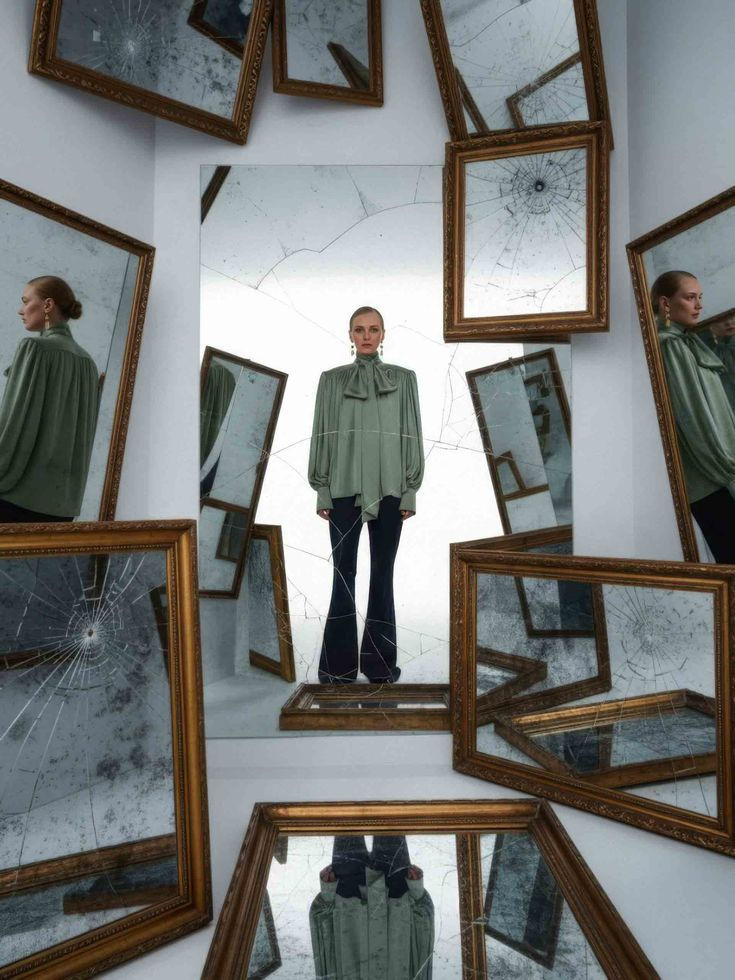
Inherited Mirror
Inherited Mirror is a creative nonfiction personal essay Sheridan wrote in her WRT 114 course, a creative nonfiction class focused on self-reflection and personal narrative. The assignment asked Sheridan to write about herself through a lived experience. In this piece, Sheridan explored how beauty standards and self-perception were shaped across generations of women in her family, using the mirror as a central metaphor. Through memories of her mother and grandmother, she examines how beauty was learned, inherited, and ultimately redefined, tracing her journey from control and comparison toward self-acceptance and care.
Inherited Mirror
The mirror in my mom’s bathroom was always spotless. The marble countertop stayed perfectly polished, with no sign of life on its surface. Growing up, I thought beauty worked like that bathroom countertop. Something was wrong if there was even one smudge, stray hair, or fingerprint. I remember tracing the smooth surface with my fingertips, wondering what was tucked away behind the cabinets and drawers. Everything looked perfect from the outside, but I could sense that perfection required constant effort. Even then, I understood that beauty was not effortless. It was maintained.
Yet underneath that countertop, there was life, and a lot of it. It was simply concealed beneath the rigid, shiny white surface. Every morning as a child, I watched my mom sit at her bathroom counter and get ready for her day. Sunlight would stream through the skylight above her and hit her just right. She always told me the importance of the sun when doing one's makeup because it allowed you to see every detail. I paid close attention to each step, watching every stroke of her carefully curated routine, as if she had practiced it her entire life.
I often sat beside her, hoping to learn her secrets. Sometimes she lets me try her new products, dab a bit of blush on my cheeks, or swipe on her clear lip gloss. Those small gestures felt like an initiation, like I was being taught a quiet language passed down from mother to daughter. I wanted to know everything, from why she chose one palette over another to how she decided if a day called for a bold lip or a soft one. Her routine looked like art, and I wanted to master it someday.
She always started with a flawless base and finished with mascara, blush, lipliner, and lipstick. Every step used the same small, practiced motions, always in the same order. I sat on the edge of the tub and watched. She never rushed. Getting ready was not something she had to do. It was something she chose.
To her, it was never about vanity. It was about care. “When you look good, you feel good,” she would tell me while leaning toward the mirror to fix her lipstick. I loved watching her transform each morning, but part of me also felt the pressure behind it. Somewhere between admiration and imitation, I began to believe that beauty was something you earned, not something you simply had.
At school, I noticed the girls who seemed effortlessly perfect, with smooth ponytails and legs that looked good in everything. I would adjust my clothes in the bathroom stall, trying to smooth the parts of me that refused to cooperate or shift the way I stood to make myself appear smaller. I memorized what people complimented and what they did not. Beauty felt like a game everyone else understood while I was still learning the rules. Was it something people naturally excelled at, or was it a skill that required precision and time? My mom used to say she never felt pretty growing up and did not grow into her beauty until she was older.
As a child, I felt the same. I was bigger than the girls in my class, had oily skin and acne, and spent years with jack-o-lantern teeth. I hoped I would follow the same path as her, that maybe in time I would grow into my beauty too.
As I got older, I learned my mom’s rules. Straighten your hair. Keep your nails clean. Dress presentably. Never leave home without a full face. Smile even when you do not feel like it. I noticed how appearances came first to most people, how compliments about clothes or hair came more easily than ones about personality or kindness. I started to believe that looking a certain way could protect me or make life easier.
For a long time, I equated beauty with control. My mother presented everything flawlessly, whether it was her hair, her outfits, or our spotless home. I believed that if I kept everything polished, I could feel that same stability. But perfection was exhausting, and it never lasted.
I can still picture the mirror in my middle school bathroom. On the rare days I felt confident, that mirror always broke the spell. It was too bright, too honest. I remember tugging at my shirt or pulling down my skirt, wishing I could trade places with someone else for a moment. The girls around me looked effortlessly beautiful. Even if they never noticed themselves, I noticed everything about myself.
I learned how to suck in my stomach just enough so my ribcage showed when someone walked by, and how to tilt my face in photos to hide what I hated. The mirror became a scorecard. Good hair day, plus one. Breakout, minus five. I thought if I fixed my skin, my weight, or my teeth, everything else would fall into place. I repeated my mom’s words, “When you look good, you feel good,” but they began to sound like expectation rather than comfort.
It was never her fault. Beauty had always been a kind of inheritance in my family, passed down like jewelry. My grandmother never left the house without perfume and her red nails were perfectly painted. She loved telling stories about her 20-inch waist, the dresses that fit her perfectly, and the heads she turned. I wondered whether beauty opened doors for her, and if so, whether those doors would close for me. I wanted to look like I belonged, but more than that, I wanted to feel like it.
To the women in my family, the presentation was self-respect, a way of saying you were worth being seen. But I did not always feel so. I questioned who I was getting ready for. Myself, or everyone else.
In college, something shifted. Maybe people who did not know my history or being in spaces where constant self-critique felt out of place were surrounding it. I began redefining beauty for myself. I noticed how beauty extended beyond appearance, how some people lit up a room the moment they walked in, or how quieter people carried their own kind of beauty. There were days I left the house without makeup and felt fine, and nights I dressed up simply because it made me happy. Somewhere in that balance, my mirror began to change. It was no longer a place I dreaded or stared into for hours. It became a place of contentment.
Fitness, food, and skincare became less about control and more about care. I began moving my body because it felt strong, not because I wanted it smaller. I cooked meals that made me feel good, not guilty. Beauty became a space of passion instead of pressure.
The more I cared for myself, the more I realized beauty was never meant to be about perfection. It was meant to be about peace. Studying advertising and fashion design expanded this idea even further. Beauty became a language. In class, we discussed how brands shape, stretch, and sometimes distort beauty. I learned that, like people, every mirror reflects something different. Beauty existed in culture as much as in individuals.
That realization changed how I approached my work. I loved the campaigns that did not hide anything, that showed freckles, stretch marks, curly hair, and individuality. I saw myself in those images, and I saw the younger version of me who once stood in front of mirrors wishing she looked different. I wanted her to know she did not have to. I realized the kind of beauty I wanted to create in the world was honest. I wanted campaigns where young girls felt seen, not measured. My reflection stopped being a checklist and became something I protected.
Beauty feels quieter now. It is not something I chase. It is something I carry. It is how I walk into a room, how I treat others, and how I show up for myself even on difficult days.
When I visit home, I still watch my mom get ready. Her movements are softer now. I see her routine differently. Rather than chasing perfection, she is simply caring for herself. I still slip into old habits sometimes, comparing myself or analyzing my appearance too closely, but I know how to pull myself back. I remind myself that beauty lives in how gently I speak to myself in difficult moments and how confidently I take up space in good ones. It is a love story I continue to write with myself.
Now, when I pick up my makeup brush, I do not use it to fix anything. I use it to honor myself. When I look into the mirror, I see pieces of her in my face and smile. I thought the mirror judged me. Now I understand it recognizes me. It does not reflect the polished version I chased for years, but the whole version that exists beneath it. The light that hits me now does not expose flaws. It reveals everything I have grown into.
The mirror does not feel heavy anymore. It feels like home.